
Spring in South Korea
Updated: Jul 2

The world...is like a passing cloud, like an imaginary wheel made by a whirling torch,
like a castle of spirits, like the moon reflected in the sea, like a vision, a mirage, a dream.
The Lankavatara Sutra
I remember when I arrived in Japan the very first time, and I felt like my world had been turned 180 degrees. Everything was strange and different, and I couldn't even say 'thank you' in the language. My passion for the country in the intervening years has meant a deep dive into the early literature and history, and a lot of study of the Japanese language.
Travelling to South Korea puts me almost right at the very beginning again. I learned the Korean alphabet Hangeul before I went, but don't know what anything I read means! I read the Korean classic The Nine Cloud Dream, which is interestingly set in Tang Dynasty China. I wonder if perhaps there will be overlaps with things I recognise from Kyoto.
I mainly watch Japanese drama, but I move into K-drama: Crash Landing on You, Hometown Cha Cha Cha, Bon Appetit, Your Majesty, and My Royal Nemesis. I watch YouTuber Korean Englishman and a ton of BTS!
I plot a trip from a map, working within a 3-hour driving radius from the capital, Seoul. There's a National Park near the east coast which looks very beautiful from the photos I can see. It looks like a perfect destination for a one week trip in early May.

Our week began - we were in a rental car, driving with the early morning weekday traffic through Seoul, along the magnificent Han river, with the giant Lotte Tower looming directly ahead like Saruman's Orthanc in The Lord of the Rings!
As we left the gleaming city behind, the landscape swiftly became mountainous, and clothed in a vivid green light that came from the new green leaves of endless forests. May in South Korea brings a dazzling light - I was aware of shadows, light dancing, and what seemed like endless nature.
Good speed limits on the busy roads made the drive smooth and methodical. As soon as we drew away from the skyscrapers of Seoul the landscape became dominated by nature – for miles. All the way as we journeyed on the empty expressways to the eastern coast of South Korea, we were amazed by the beauty of the mountains, fresh in their variegated vivid spring greens, and the townspeople’s responses to that all-encompassing nature, with their small plots of land for growing rice and vegetables, little orchards, and brightly coloured flowers.
We were driving east, right across the country to the little coastal town called Sokcho. This was to be our base as we explored the Seoraksan National Park - South Korea's original national park, inspired by a Presidential visit to Yosemite to protect this wondrous landscape which had once been part of North Korea.

Sujongsa
Turning off the expressway, we made our way via a small town to the rumbly mountain road which switchbacked up a steep mountain side. The car was struggling to get up the steep slopes!
Finally, in the heart of forests of many variegated greens and dappled light, we stepped through a temple gate, walked up a steep, rocky path, and found ourselves in a breath takingly beautiful temple complex, which had views beyond across a river plateau and mountains.

I'm used to the restrained colour palette of Kyoto, and so I was astonished by the vivid waterproof lanterns that swung in rows of rainbow colours above our heads along the main street!

A service was about to start, and ladies rushed to a small temple building, took off their shoes and quietly stepped inside to kneel and pray. A monk began to chant and the sound reverberated throughout the mountainside, above to the temple building which overlooked the complex, and where at the foot of the path there was a cute frog water feature uttering sounds of bubbling water.

I was so delighted when we discovered a tiny temple building had been converted into a cafe! I drank chocolate latte as I tried to take in this astonishingly beautiful, serene place.

Sokcho
We drove for three hours on the easy-going expressway, marvelling at the continued beauty of the mountains, and noticing large banks of a plant that looked like wisteria or laburnham along the roadsides. We stopped at a service station, a lively place full of families en route for Golden Week.

We continued to the east coast and drove into the little resort and fishing port of Sokcho.
Sokcho is a charming small Korean holiday resort, with a sandy beach, a small strip of beach shops for browsing, and multiple restaurants. We stayed at the Homm Hotel, drawn in by its rooftop infinity pool which stayed open till late. Every night we floated and swam in the warm waters, and, resting our elbows on the edge of the pool looked out across the tiny harbour which was lit up in gaudy yellows, reds, purples, and blues. Out to sea a lighthouse blinked in the black. The harbour had a few fishing boats tied up, and nearby was a fish market, and seafood restaurants under polythene.

Seoraksan National Park
The Seoraksan National Park is dazzling even from the car park, where the car park operators ask you to park and leave your car keys in the car, so that they can move it to a more organised space.

I'd read the blog of What's Dave Doing about the park, which is an excellent guide to the various trails and hikes. We opted to walk the breezy Biseondae Rocks trail. It was a beautiful walk along a tumbling mountain river, and several times we scrambled down to its banks and stood on little rocky islands in the middle of the rushing water - the views to the mountains were very beautiful.

At the head of the trail is a bridge which carries you over the ravine. There are sheer cliffsides to look up and the refreshing mountain water pools in the rocks as it tumbles down. And there's a kiosk over the other side of the bridge, and if you sign in with the park guide you can walk through the gate and clamber up the rocky bouldered path and quickly ascend the mountain.

But first, you have to attend to the mountain chipmunks who rush out brandishing walnuts and peanuts at you, that have been gifted to them by earlier knowing hikers. The chipmunks are so tame! They followed us like little mountain guardian spirits granting access to the magnificent climb ahead.

I climbed the path sometimes on all fours, reaching out for the boulders in front as I made my way up to the first look out point. We were in the tree line, and I cannot emphasise enough the swaying green of the fresh leaves, and the sounds of the air through the leaves. It was forest and sky, and that dazzling brilliant sunlight.
The final push took us to a metal bridge which was bolted onto the sheer cliff face and which leaned perilously to the right above the drop. The staircase of the bridge had backless, see-through steps, and I discovered I have a bit of vertigo at this point, and very much held to the side that was bolted to the mountain!
Seeing Korean ladies scrambling across made me pull myself together though!

Now we were on a small plateau of rock with dramatic mountains encircling us, leaves dappling the light, and strong breezes whipping round us.

And then we saw that there was further metal staircase climbing up a higher cliff face. And it reached into a cave in the mountain. The staircase was easy to climb, and the cave was like nothing I have ever seen before. It's a Buddhist cave, and burrowed into the rock at the back is a shining altar in the gloom, lit by a single candle. A single candle in this unlikely place, quiet and hidden amongst the majesty of the mountains.
It spoke to a past when Buddhism was banned, and temples isolated themselves in remote but beautiful places.

The climb down was breathtaking! There were all sorts of interesting plants around us.

Back down in the park we sat in a cafe next to the rocky river bed which had small towers of river stones everywhere you looked. They looked like the little Shinto spirits in Ghibli's Princess Mononoke!

Cheoksan
And later still at Cheoksan, the community footbaths were very welcome! For a few won, we were given a small foam mat to sit on and a small towel.
After washing our feet at the tap, we plunged our tired feet into the warm and relaxing water and sat watching the lively communal fun between the Koreans who sat with us. There were children playing near their parents, a group of teenage girls on their phones, a group of older ladies there for a chat.
The grandmas who ran the place and sold the boiled eggs from a collapsable table in the corner, had opened a bag of sweets when we went to return the mats and towels. They shared their delicious gummy tadpoles with us with big smiles!

Naksansa
Naksansa is a temple above the inky roiling Japan Sea. The monk's extraordinary chanting reaches out across the waves. The temple complex is very beautiful, and reached via an earlier colourful temple before a pool filled with dark fish, and where large transparent-winged black butterflies flutter past on the breezes. Vivid lanterns sway overhead in the light airs, casting a carpet of shadows beneath your feet.

Little market stalls line the car park outside the temple, selling all manner of fish including giant dried stingrays!


Surffy Beach
There is a lot of surfing action along this east coast of South Korea. I read that Seoul professionals like to come down at weekends and hit the beach! Surffy Beach is a great stop along the coast, the sand is warm and soft under your feet, the waves are deep green and navy blue, the beach cafe is very cool and hipster.

Bohyunsa
We've been following a small South Korean templestay for several years on Instagram, and they follow us too and often like what we do! So when I discovered that we would be nearby we had to go and see them!
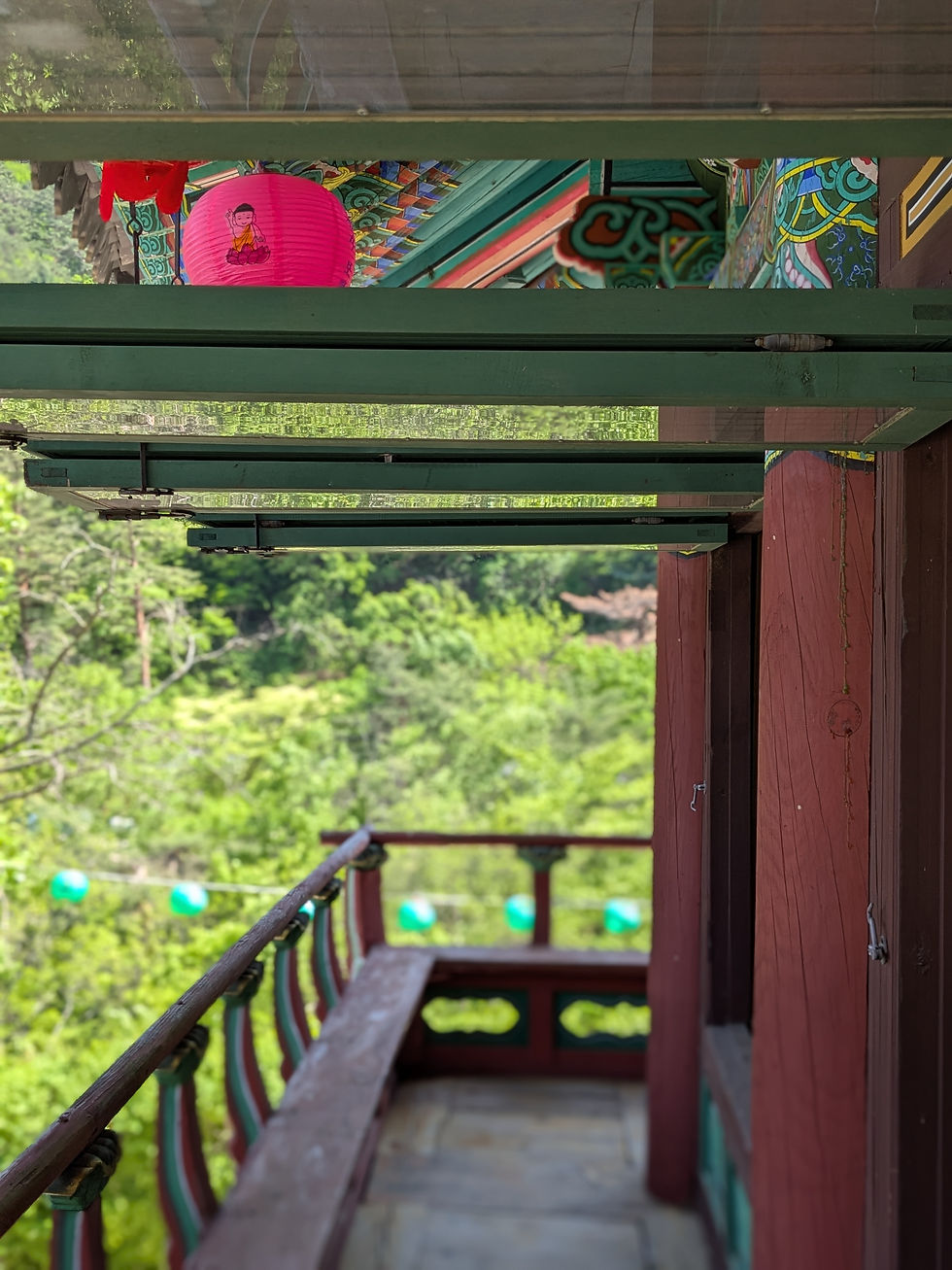
Bohyunsa was possibly the most astonishingly beautiful, other-wordly temple I have ever visited.

It was a warm day, and Bohyunsa is perched up in the leafy mountains with a distant view down to the river. It was quiet with very few people about, and the serenity and stillness was only ruffled by two little redstarts which fluttered along the temple rooftops.

How do I describe this place? The brightly painted temple buildings mainly sat at the edge of a small central courtyard. They had beautiful illustrations painted onto them, from stories - I wish I knew the significance. Certainly, some gorgeous illustrated goddesses made me wonder about the Korean classic The Nine Cloud Dream (Kuunmong) which I had read before I came away.

It's a story set in Tang dynasty China, about a Buddhist trainee monk called Seongjin, who allows himself to dream of the eight ladies he meets by a bridge, and is taught a lesson by his master. He is reincarnated as a high-achieving official with beautiful wives and consorts. This is so that he may learn what is important in life.
At the height of his fame, Seongjin's master steps into his dream and wakes him.
The ladies in the paintings made me think of the ladies in the story, who are also Buddhist goddesses.
But it's likely the painting is of Gwan-eum, the goddess of mercy and compassion.

Many of the temples that we saw on our trip, including the ones in Seoul seemed to offer templestay. You can find out more about it at eng.templestay.com. I would love to stay at Bohyunsa!
Jukdo Beach
We stopped off at cute Jukdo Beach for matcha on our way back to Sokcho. There was a lovely, warm laid-back vibe here - a ring of cafes and surf shops line the beach. Our cafe had put cushions on the outside steps so we could sit on the warm stone and look at the sea!

Nami Island
We left Sokcho and drove the quiet expressways back to Incheon to return our car, stopping at service stations and cute Nami Island along the way. Nami Island involves a fun ferry ride across a beautiful lake, landing at a sweet island park full of gardens, cafes, and a proper holiday spot.
Seoul
After dropping off the car we caught the hotel bus back to Incheon airport, and from there hopped on a limousine bus which took us to Anguk station close to the main Gyeongbokgung palace in the heart of Seoul, and close to Ikseondong and our hotel.
We stayed at the hanok-style DAAM hotel, located in the back streets near to the very cool Ikseondong streets which are full of restaurants and cool bars, so it was easy to find places to eat. This part of Seoul reminds me of the Beijing hutongs – those narrow walk-way streets full of beautiful old buildings resonating with history!
We had two days in Seoul, the following day made incredibly exciting by our beloved family joining us from Japan!

We began our first day in Seoul by opting to walk through the busy streets of the city to the N-Seoul Tower. We wandered into beautiful Unhyeongung as we were passing. So reminiscent of Kyoto, it's a beautiful collection of 19th century buildings, built for the residence of the father of the 26th king of the Joseon dynasty.

We caught glimpses of BTS' V advertising coffee!

And we made our way to the base of the N-Seoul Tower, and climbed the wooden staircases through the leafy woods to the top. The views across Seoul are fantastic, and it was such a good way to begin our time in Seoul!

We came down on the cablecar and walked through the bustling streets of Nandaemun market. Many women walked by carrying wrapped bundles of flowers, and we found the flower market and could barely move for all of the women puchasing baskets and bouquets. I think it may have been for Parent's Day. I loved the towering tables of peonies, roses, delphiniums - all types of colourful flowers.
We stepped back into the busy streets of the market only to get enveloped in the chaotic bustle of sharp-suited security guards protecting Korea’s President who was doing a walkabout to cheering crowds!
We followed the excitement towards the Sungnyemun Gate, where the silken-attired guards stood with their beautiful flags, and popped into nearby Isaac Toast – renowned if you too watch the Korean Englishman YouTube channel!

As we walked through central Seoul it felt like nature had purposefully been brought into the city to enhance it as a liveable space. I’m thinking especially of the beautiful river which runs through the heart of the city – the Cheonggyecheon – which not only has soft, curved edges for seating, but wild plants like iris to make the water healthy. The river is alive with waterfalls and textured paving underneath which create splashes and swirls in the water; it brings life to the water and oxygenates it, cooling the city centre. This calm space was once a highway.
As this amazing recreational space wound its way between the dazzling towers of Seoul, we entered reading spaces – tables and lanterns left out for anyone to enjoy sitting at at night. Brightly coloured paper-style lanterns swung overhead. I loved these spaces so much – truly a fantastic example of how city living can be designed to enhance the well-being of the local community.

The reading spaces were a part of a festival for Seoul Library. Books feature largely in Seoul, and as we walked at length through the city over two days, we discovered large reading plazas full of soft-covered reading mattresses, tables and boxes of books, for anyone to sit down and enjoy.
And the books catered for serious readers. At the heart of the main outdoor reading plaza outside Seoul’s beautiful city library, on the bookcases were rows and rows of English and Irish classics – here you could casually pick up Ulysses, or Wuthering Heights, it truly was impressive.

I was searching Naver Maps for a Bukchon tea store, but it had no results, but beguilingly suggested the Bukchon Lounge Teaclub Cha Cha instead. My feet couldn't move fast enough to reach there!

I love tea experiences. Nothing can overshadow my times with Mai in the beautiful, graceful teahouses of Kyoto, but I loved the moon-viewing platform tea house in the gardens of Kowloon where they brought all of the implements out of a little store built into the table, and I loved this experience in Seoul, where the tea was so delicate, fragrant, and delicious!

It was a little part of Seoul’s Kyoto, an extraordinary tea house framed around a central narrow courtyard, with tiny tea rooms built either side into the traditional hanok buildings around the edge. I could see that beyond the tea rooms on the left of the courtyard was a little garden. We sat on the right side, and we took off our shoes to step up onto the wooden platform, then over the sill of the little shaded room, and into it to sit at a tiny lacquer table on cushions on the floor.
I ordered summer tea, as I had been so impressed by the light of the new-green early summer mountains.
A young woman came to show me how to make the tea, by pouring the rolled dark leaves into the tiniest ceramic teapot you can imagine, pouring the kettle of hot water over the leaves, waiting thirty seconds and then using a ceramic strainer to strain the tea into a glass, before finally pouring the tea into a small bowl and tasting. Oh yes, it tasted heavenly delicious!
We ordered desserts with our tea: a black sesame dessert for my husband, and a vivid Korean matcha and red bean paste dessert for me!
What a place!

I loved this place – I loved the noren-style curtains waving in the soft breezes; the little metal fish bells tinkling, the beautiful wood and stone buildings, the handmade mulberry paper in the fretted sliding doors.
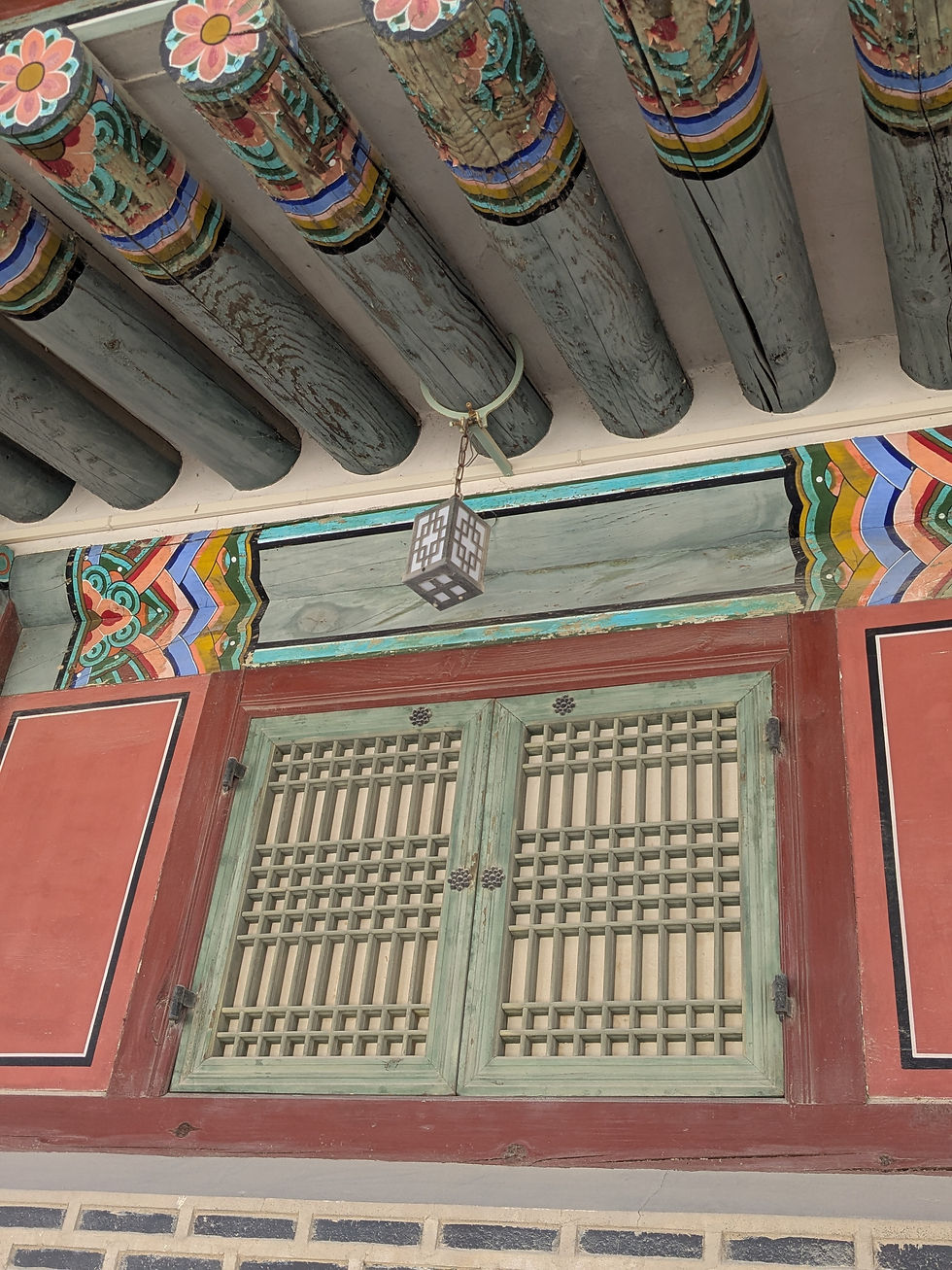
On our second day we started at a cool café and then walked through the palace grounds of the Gyeongbokgung . We were drawn by the drums and silk-dressed guards carrying dazzling silken flags at the entrance. Many people had dressed in beautiful hanbok - it creates a wonderful atmosphere at the palace!

Then we crossed the stepping stones of the Cheonggyecheon river, with the light and lanterns dazzling overhead.
Seongsu is a wonderful area of cool shops and cafes which reminded me a bit of Daikanyama in Tokyo.
We walked through the beautiful tiny gardens of a busy Saturday family Seoul Forest, and then we walked up onto the massive Seongsu bridge which spans the huge Han river and has views of both the N-Seoul tower and the Lotte Tower. We must have driven here on our first day in South Korea!

We walked through very beautiful temples in Seoul which were getting ready for the Lantern Festival.

We walked through Apgujeong and Gangnam, stopping at London Bagel Museum – which is actually a café – for old times sake!
We dropped by the amazing COEX Starfield library with its high wall displays of books - it certainly lives up to its Instagram hype!
We finished our wonderful time in Seoul with a Korean meal of bibimbap and side dishes in a lovely restaurant, where I discovered I love kimchi, and the side dishes of soy-marinated things and crunchy garlic and fiery pasted things, and that sundubu-jjigae (soft tofu stew) is the most delicious of all!
In the evening we were back near Ikseondong, and we met under the soft dusky shadows of the large hanbok café Onion. It's a beautiful space - a large traditional building with a central courtyard, dark and softly lit, where there is a raised area with simple cushions to sit on, or an adjacent area through glass of tables and chairs.

I was dazzled by South Korea in the springtime. I was really taken by the light and the vivid greens of the new leaves – the multiplicity of trees creating a beautiful variegated colour palette. The country seems to be all nature: mountains, rivers, beautiful sea, and I was so impressed by how nature had been deftly brought into that gleaming capital city, and used as a resource to create calm spaces and a healthy environment in which to live.
I loved the emphasis on books and reading, from the seating installations of Seoul Library in parks, plazas, and especially along that beautiful central river. I am astonished by the boxes of books that were left alongside comfy seats and lanterned tables.

I hope this travel journal is of use to you if you plan to go to South Korea,
and that you have enjoyed reading it!
Cathy
x
Sources and Further Reading
Kim Man-Jung, (trans. Heinz Insu Fenkl), The Nine Cloud Dream, Penguin Classics.
What's Dave Doing: Seoraksan National Park detailed blog.


Comments