
The Sound of the Mountain by Yasunari Kawabata
Updated: May 18
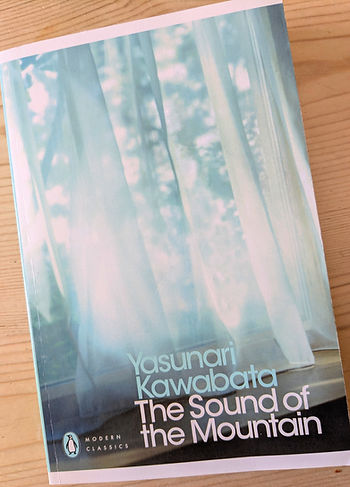
Some thoughts about The Sound of the Mountain
Kawabata's The Sound of the Mountain is set in the old samurai capital Kamakura within sound of the sea.
This extraordinary novel is structured and presented with spare refinement. Phrases and dialogue are distilled in order to achieve the very essence of emotion and meaning. It is reminiscent of a haiku.
As with Kawabata’s other writing, it’s intriguing to view the novel through the lens of a Japanese sumi-e, an ink painting, where the negative space (ma) is just as important as the actual ink on the paper.
Just like in ikebana, traditional Japanese flower arranging, a space is left for your imagination to flow through.
Every sentence is placed for a purpose. The whole becomes like a multi-faceted diamond which you can turn in the light, with each shining plane a subtly different facet of meaning.
Each short passage layers resonance upon resonance until the delicate complexity harmonises within the whole. Perhaps it comes together like the complex and sensitive sound of the koto, the traditional Japanese floor harp.
I say that because I marvelled at the influence of The Tale of Genji within the opening of the text. This is considered the world's first novel, written by the court lady Murasaki Shikibu, who served an empress at the Kyoto imperial court over a thousand years ago. It is the foundational classical text of Japanese literature, and echoes of it run through all of the traditional Japanese arts: kabuki, Noh, geiko dance, kimono, tea ceremony, gardens, manga, and modern Japanese literature.
The ancient waka poetry which features so heavily in Genji adheres to firm rules regarding its composition. Foremost is the poem’s relation to the seasons, which are clearly defined through sentimentalised images of cherry blossom, and maple leaves, all of which carry a resonance with the Buddhist mono no aware: the transience of life.
In The Sound of the Mountain, the cherry blossom and the maple leaves, which are now iconic images in Japan of Spring and Autumn, have come to symbolise the two unattainable loves of Kawabata's protagonist’s life. His name is Shingo.
But why is the book called The Sound of the Mountain, when the plot clearly revolves around a man in his early 60s, and the family he has created around him?
Let’s go back to the passage which appears at the beginning of the novel:
Though August had only begun, autumn insects were already singing.
He thought he could detect a dripping of dew from leaf to leaf.
Then he heard the sound of the mountain.
It was a windless night. The moon was near full, but in the moist, sultry air the fringe of the trees that outlined the mountain was blurred. They were motionless, however.
Not a leaf on the fern by the veranda was stirring.
In these mountain recesses of Kamakura the sea could sometimes be heard at night. Shingo wondered if he might have heard the sound of the sea. But no – it was the mountain.
It was like wind, far away, but with a depth like a rumbling of the earth. Thinking that it might be in himself, a ringing in his ears, Shingo shook his head.
The sound stopped, and he was suddenly afraid. A chill passed over him, as if he had been notified that death was approaching. He wanted to question himself, calmly and deliberately, to ask whether it had been the sound of the wind, the sound of the sea, or a sound in his ears. But he heard no such sound, he was sure. He had heard the mountain. [p.4]
This opening passage sets out the central themes of the novel. The poetry of the prose reaches back a thousand years: it echoes Heian Japan in traditional waka poetry form. In this way, the novel is set out as a lament for old Japan, the traditional Japan that through war and fire is being lost and modernised.
The sound of the mountain rumbles with Shingo’s fear of his mortality, but also his regret over lost love, and that sense that a man in the last chapter of his life will inevitably confront: the regret over what might have been.
The rumbling of the mountain is shaking Shingo's foundation, and causing him to search his memory for answers.
Shingo’s deepest memory is his unrequited love for the older sister of his wife Yasuko, who died many years before.
‘Do mountains roar?’ asked Kikuko.’ But you did say something once, Mother – remember? You said that just before your sister died, Father heard the mountain roar.' [p.12]
It’s the roar of loss: lost love; lost Japan: the losing of memory, and squarely faces the approaching loss of life. And it carries within it an aching nostalgia.

Complex family relations
The era of the novel can be pinpointed to about 1950, when the Western way of clarifying age (i.e. from the moment of birth rather than conception, known in Japan as kazoe-doshi) was introduced. The novel is set in the post-war era, within the shadow of the Japanese defeat.
Evolving modern Japan is very different to the Japan that Shingo looks back to. Traditional Japan is exemplified particularly through Shingo’s elegant daughter-in-law, Kikuko, and through set scenes such as the seven-hundredth anniversary of the Buddhist capital Kamakura, with its procession and matsuri which is at the very heart of the novel.
The adult children of the new, post-war Japan are depicted in the novel as troubled: the marriage of the daughter Fusako is falling apart and her eldest small daughter Satoko is unsettled, and the son Shuichi is married to beloved Kikuko but seeks relations elsewhere.
Contrasts are finely drawn between the beauty of the traditional dance at the festival, and Shingo’s granddaughter crying out for water, bitterly disliking ceremonial matcha tea, and shockingly grabbing a dancer’s kimono.
With the exception of Kikuko, the family that Shingo and his wife Yasuko have created are unhappy and disaffected.
The daughter-in-law Kikuko, however, is drawn in a very different way. She reminds Shingo of his first love. Kawabata frames her in front of dazzling yellow gingko leaves before she sinks into the shadows of the novel, ignored, dutiful, and oppressed.
From the outset, Kikuko clearly has tremendous fondness for her father-in-law Shingo. They share a sensitivity towards the traditional arts of Japan: poetry; gardens; kimono; tea, and tea ceremony.
Shingo’s fondness for the daughter-in-law who his son Shuichi treats so badly, is complex and conflicted. He is troubled by dreams which are clearly longings for this woman who is the embodiment of Yasuko’s sister, who was a woman of elegance; of higher status; a woman with whom he conjectures his family life may have been more of a success.
Shingo wonders whether not marrying Yasuko’s sister was his first mistake. His unhappy children seem to spring from this mistake.
And Shingo cannot even confront his dreams of clear longing – he turns away from his laid-bare feelings.
But as we disapprove of the way that Shingo’s son Shuichi behaves; the reality of his life experience is revealed to us. We understand that as a soldier fighting in the war his perspective has shifted greatly from the viewpoint of his father. Shuichi and his mistress have both suffered experiences shaped by the war, and their more liberal way of thinking, adopted possibly from the influences of the Americans around them, forge new, more liberated ways of living.
Kikuko
I love the way that Kawabata has crafted our perception of Kikuko in this novel. At first, she is portrayed indirectly: she will appear at the end of a passage dutifully holding a kimono for Shingo when he returns from work; or when a dramatic family argument rears its head we learn that Kikuko has been in the garden all the time, serving the family, fetching water from the well.
But two-thirds of the way into the book, there is a beautiful passage set when Shingo and Kikuko meet in Shinjuku-gyoen. Always a beautiful space, here, Americans are ambling through the park, and when Shingo sees Kikuko she is sitting on a bench, framed again by gingko. There is a poignant line:
Kikuko stepped out of the shade. [p.142]
And, indeed, she does step out of the shade. Into the park beyond the dazzling gingko trees, and into her own story.
Conclusion
I loved this novel. There are poetic passages which resonate with the elegant beauty of traditional Japan, and they contrast with the devastation of the family's real-time story.
It is definitely a book which would benefit from reading again, it is deep and richly textured.
Sources
Yasunari Kawabata, (translated by Edward Seidensticker), The Sound of the Mountain, (Penguin Modern Classics, 1970).
Photo from the movie Yama no Oto (1954), Japanesefilmfestival.net


Comments